
The leader score: global vs community-conditioned NCE
Source:vignettes/articles/leader-score.Rmd
leader-score.RmdIs the NCE measuring the right thing?
The paper’s Node-Connection Entropy uses the global connection probability . But a hub whose degree is spread across all communities can maximise this score while being a poor community leader. Since a score is a simplification, it is worth checking what it actually rewards — which motivates a community-conditioned alternative:
exposed in the package as nce_local_score(). We measure
how often the designated leader changes when re-picked
under the local score.
d$results |>
  dplyr::group_by(graph) |>
  dplyr::summarise(
    communities       = round(mean(n_communities), 1),
    H_global          = round(mean(H_paper_global), 3),
    H_local           = round(mean(H_paper_local), 3),
    pct_leaders_changed = round(mean(pct_leaders_changed), 1),
    .groups = "drop") |>
knitr::kable(caption = "Mean leader-score values and the fraction of leaders that change identity under the local NCE.")| graph | communities | H_global | H_local | pct_leaders_changed |
|---|---|---|---|---|
| Dolphins | 5.0 | 0.581 | 0.741 | 80.0 |
| Karate | 3.0 | 0.840 | 0.598 | 100.0 |
| Polbooks | 5.0 | 0.535 | 0.736 | 80.0 |
| SBM_5 | 5.1 | 0.343 | 0.764 | 33.7 |
library(ggplot2)
ggplot(d$results, aes(graph, pct_leaders_changed, fill = graph)) +
  geom_boxplot(alpha = 0.6, show.legend = FALSE) +
  geom_hline(yintercept = 10, linetype = 2, colour = "grey40") +
  labs(title = "Leaders reassigned when switching global -> community-conditioned NCE",
       subtitle = "Dashed line = 10%: above it, the NCE choice materially changes who is a leader",
       x = NULL, y = "% of leaders changed") +
  theme_minimal(base_size = 10)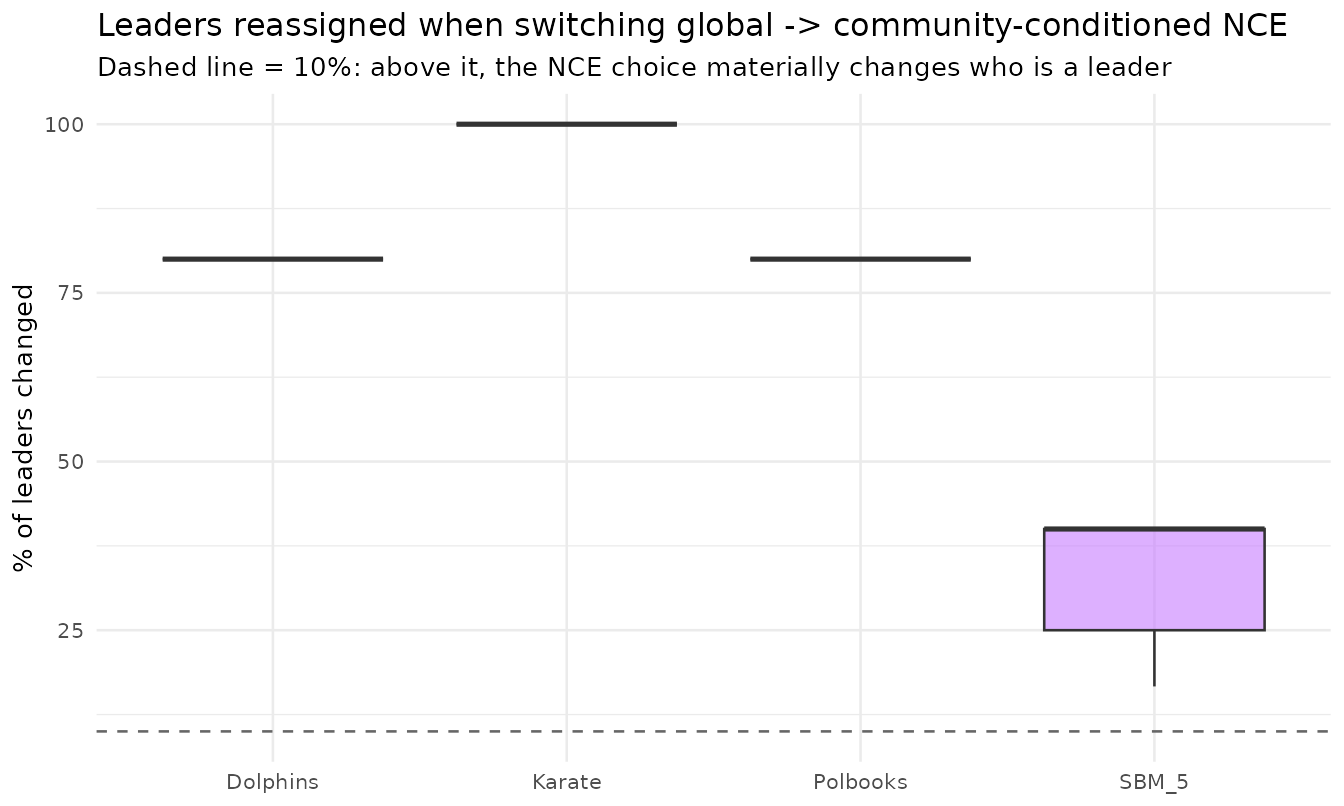
Reading. If the change fraction is non-trivial
(above ~10%), the choice of NCE definition is not an
interpretive detail — it materially decides who is crowned the leader.
Both scores are exported (nce_score() and
nce_local_score()) precisely so this comparison is part of
the contribution rather than buried.
Reproducibility and data provenance
The comparison above is read from a dataset shipped with the package;
nothing is re-run at build time. Each dataset records the package
version that generated it (not necessarily the version
you installed: the generators are re-run only when the algorithms
change), the release it first shipped in, and a SHA-256 checksum
matching inst/extdata/SHA256SUMS:
lcda_provenance("nce_alternatives")
#>            dataset generated_by generated_on first_release shipped_in
#> 1 nce_alternatives        0.3.1   2026-05-31         0.3.1      0.3.2
#>                                                             sha256
#> 1 19271bb3e20da57a7bf0bd51045f7fc92f925b2993d11d29ec0763a1c72f92a3
Regenerate with data-raw/80_nce.R (single documented
seed).
Honest reading. The global-vs-community-conditioned NCE comparison is a structural contrast of two exported scores, not a downstream-utility claim; relatedly, the lexicographic tie-break is empirically never decisive (it fired in of iterations across the pool-sensitivity sweep), so acts as a tie-breaking safeguard rather than a search driver.
References
- Ospina, R., Silva, G., Matos Junior, F. J., Leite, A., & Ochi, L. S. (2026). A GRASP Framework for Community and Leader Detection in Complex Networks. Preprint.
- Akachar, E., Bougteb, Y., Ouhbi, B., & Frikh, B. (2025). LeaDCD: Leadership concept-based method for community detection. Information Sciences, 686, 121341. doi:10.1016/j.ins.2024.121341