Constructs a two-sided tabular CUSUM chart for a single column of
individual measurements. Two cumulative statistics, C+ (upward)
and C- (downward), are accumulated against a target with a
reference value k; an alarm fires when either crosses the
decision interval h * sigma.
Usage
shewhart_cusum(
  data,
  value,
  index = NULL,
  target = NULL,
  sigma = NULL,
  k = 0.5,
  h = 4,
  locale = getOption("shewhart.locale", "en"),
  verbose = NULL
)
Arguments
- data
A data frame.
- value
Tidy-eval column reference for the measurement.
- index
Optional tidy-eval column reference for the x-axis.
- target
Numeric. Process target. Defaults to
mean(value).- sigma
Numeric. Process sigma. Defaults to
MR_bar / 1.128.- k
Numeric. Reference value in units of sigma. Default
0.5, tuned to detect 1-sigma shifts.- h
Numeric. Decision interval in units of sigma. Default
4, givingARL_0 ~ 168fork = 0.5. Useh = 5forARL_0 ~ 465(Hawkins & Olwell 1998).- locale
One of
"en","pt","es","fr".- verbose
Logical. Print progress messages?
Value
A shewhart_chart object of subclass shewhart_cusum. The
augmented slot has columns .value, .cusum_pos, .cusum_neg
(the two accumulated statistics, both non-negative), .upper
(the decision interval h * sigma), and .flag_signal.
Details
By default, sigma is estimated from the moving range of value
(MR_bar / 1.128); the target is the mean of value. Either can
be overridden via target and sigma for Phase II monitoring
against pre-calibrated values. Missing values in value are an
error, since a single NA would propagate through the accumulators
and silently disable every later alarm.
References
Page, E. S. (1954). Continuous Inspection Schemes. Biometrika, 41(1-2), 100-115. doi:10.1093/biomet/41.1-2.100
Hawkins, D. M., & Olwell, D. H. (1998). Cumulative Sum Charts and Charting for Quality Improvement. Springer.
Montgomery, D. C. (2019). Introduction to Statistical Quality Control (8th ed.). Wiley. Chapter 9.
Examples
set.seed(1)
df <- data.frame(
day = 1:80,
y = c(rnorm(40, mean = 100, sd = 2),
rnorm(40, mean = 101, sd = 2)) # 0.5 sigma shift
)
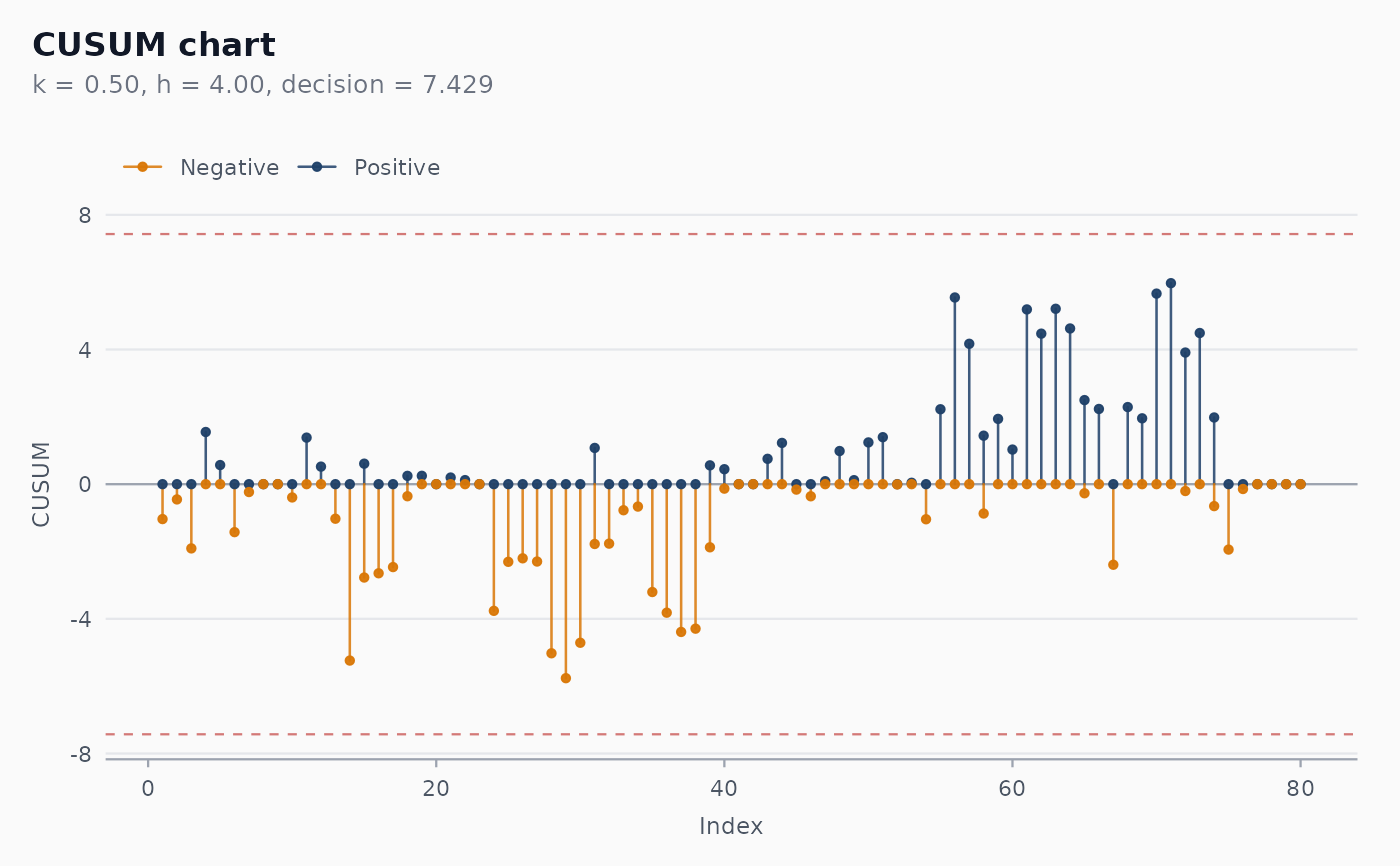
fit <- shewhart_cusum(df, value = y, index = day)
print(fit)
#>
#> ── Shewhart chart cusum ────────────────────────────────────────────────────────
#> • Observations / subgroups: 80
#> • Phase: "phase_1"
#> • Sigma estimate ("mr"): 1.857
#>
#> ── Control limits ──
#>
#> # A tibble: 2 × 3
#> chart line value
#> <chr> <chr> <dbl>
#> 1 CUSUM h_upper 7.43
#> 2 CUSUM h_lower -7.43
#> ── Rule violations ──
#>
#> ✔ No violations across 1 rule: "cusum_decision".
# \donttest{
ggplot2::autoplot(fit)
 # }
# }