Box & Cox (1964) introduced a one-parameter family of power transformations,
and a procedure for choosing by maximum likelihood. The goal is to find a scale on which the residuals are approximately normal and homoscedastic — the assumptions that classical inferential tools, including Shewhart charts, presuppose.
shewhart_box_cox() returns the profile log-likelihood,
the maximiser
,
and a 95% confidence interval based on the chi-square approximation to
twice the log-likelihood drop.
A textbook example
set.seed(2025)
y <- rlnorm(200, meanlog = 0, sdlog = 0.5)   # log-normal -> lambda = 0
bc <- shewhart_box_cox(y)
bc
#>
#> ── Box-Cox profile likelihood ──────────────────────────────────────────────────
#> • n = 200
#> • lambda_hat = 0
#> • 95% CI: [-0.25, 0.2]
The optimal lambda is near zero (log transformation), and the 95% CI should cover zero. Let’s plot the profile:
autoplot(bc)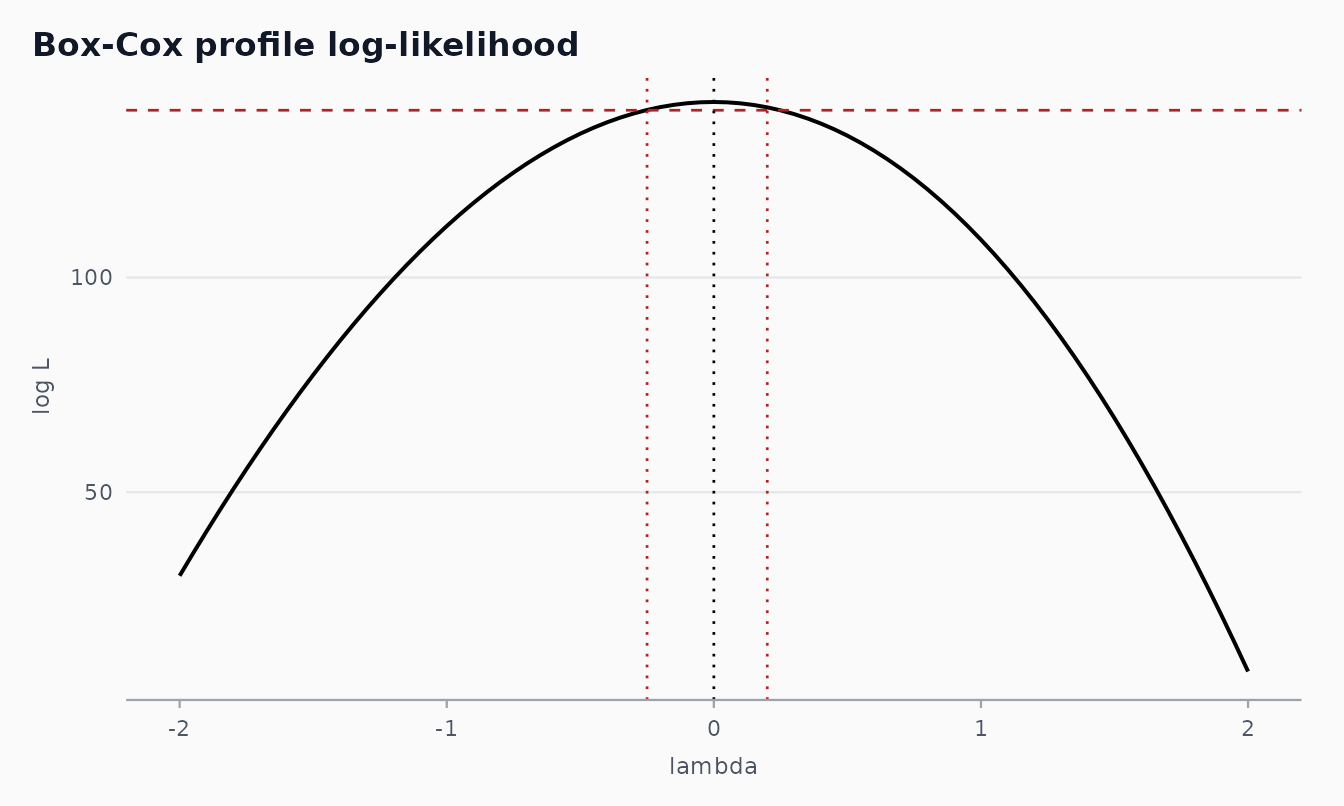
If the CI for contains 1, no transformation is needed (the data are approximately normal as is). If it contains 0, take logs. If it contains 0.5, take square roots — and so on.
Interaction with
shewhart_regression(model = "auto")
The "auto" model in shewhart_regression()
calls shewhart_box_cox() internally on the response (with a
+1 shift to keep zeros valid), phase by phase, and rounds
to the nearest rung of the ladder that the model menu offers:
-
(rungs 0 and below) →
log -
→
linear
The square-root rung
()
has no dedicated model, so it maps to linear, the nearest
weaker transform. loglog is a stronger
transform than log and is never chosen automatically;
request it explicitly with model = "loglog" when the
diagnostics call for it.
This is a guidance step, not a guarantee. Always inspect the residual
diagnostics afterwards via shewhart_diagnostics().
When not to transform
If your data are counts, proportions, times-to-event, or other quantities with a known parametric family, model that family explicitly. Box was clear about this: if you can model the right distribution, do so. Transforms exist for the case where the right distribution isn’t tractable and a normal approximation on a suitably-chosen scale is the best available compromise.
The c, u, p, and np charts in this package implement that advice:
they support limits = "poisson" (or
"binomial") for exact distribution-aware limits, instead of
relying on a transformation to coerce counts into approximate
normality.
References
- Box, G. E. P., & Cox, D. R. (1964). An Analysis of Transformations. Journal of the Royal Statistical Society B, 26(2), 211-252.
- Atkinson, A. C. (1985). Plots, Transformations and Regression. Oxford.
- Box, G. E. P., Hunter, W. G., & Hunter, J. S. (2005). Statistics for Experimenters (2nd ed.). Wiley.
- Sakia, R. M. (1992). The Box-Cox Transformation Technique: A Review. The Statistician, 41(2), 169-178.