A control chart serves two purposes that are easy to confuse, and confusing them is the most common cause of misleading charts in practice. Woodall (2000) crystallised the distinction:
- Phase I is retrospective. You have a body of historical data and want to establish trustworthy control limits. The natural workflow is iterative: look for out-of-control points, investigate whether they have assignable causes, remove those points if so, and recompute the limits. The output of Phase I is a chart whose limits are believable — points outside them are genuinely surprising.
- Phase II is prospective. You take Phase I’s limits as fixed and apply them to new data, signalling alarms when something departs from the established baseline.
Most R packages collapse the two into a single function call, which has two consequences. First, every “monitoring” run silently re-estimates the limits, so a real shift that grows over time can update the limits along with itself and never alarm. Second, the diagnostic table for Phase II shouldn’t contain “this baseline itself violates the rules” entries — but it always does in tools that don’t separate the phases.
shewhartr keeps the two distinct in code through
calibrate() and monitor().
A worked example
bottle_fill has 100 observations. Imagine the first 60
are our historical baseline, gathered while the process was thought to
be in control, and the next 40 are new data we want to monitor.
baseline <- bottle_fill[1:60, ]
new_obs  <- bottle_fill[61:100, ]
Phase I: calibration
calib <- calibrate(
  baseline,
  value         = ml,
  index         = observation,
  chart         = "i_mr",
  trim_outliers = TRUE
)
calib
#>
#> ── Shewhart chart I-MR (individuals & moving range) ────────────────────────────
#> • Observations / subgroups: 60
#> • Phase: "phase_1"
#> • Sigma estimate ("mr"): 1.288
#>
#>
#> ── Control limits ──
#> # A tibble: 6 × 3
#>   chart line   value
#>   <chr> <chr>  <dbl>
#> 1 I     CL    500.
#> 2 I     UCL   504.
#> 3 I     LCL   496.
#> 4 MR    CL      1.45
#> 5 MR    UCL     4.75
#> 6 MR    LCL     0
#> ── Rule violations ──
#>
#> ✔ No violations across 2 rules: "nelson_1_beyond_3s" and "nelson_2_nine_same".
trim_outliers = TRUE enables iterative trimming: any
observation that violates the rules is removed and the limits are
recomputed. The procedure is described in Montgomery (2019), Section
6.2.3.
calib$phase
#> [1] "phase_1"
calib$n          # potentially less than nrow(baseline) if trimming dropped points
#> [1] 60
broom::tidy(calib)
#> # A tibble: 6 × 3
#>   chart line   value
#>   <chr> <chr>  <dbl>
#> 1 I     CL    500.
#> 2 I     UCL   504.
#> 3 I     LCL   496.
#> 4 MR    CL      1.45
#> 5 MR    UCL     4.75
#> 6 MR    LCL     0
Phase II: monitoring
alarms <- monitor(new_obs, calib)
alarms$phase
#> [1] "phase_2"
alarms$violations
#> # A tibble: 0 × 5
#> # ℹ 5 variables: position <int>, rule <chr>, description <chr>, value <dbl>,
#> #   severity <chr>
monitor() does not re-estimate the limits. It
propagates the calibrated limits to the new data, applies the same rule
set, and returns a fresh chart object whose phase slot is
"phase_2".
You can plot the monitored series exactly the same way:
ggplot2::autoplot(alarms)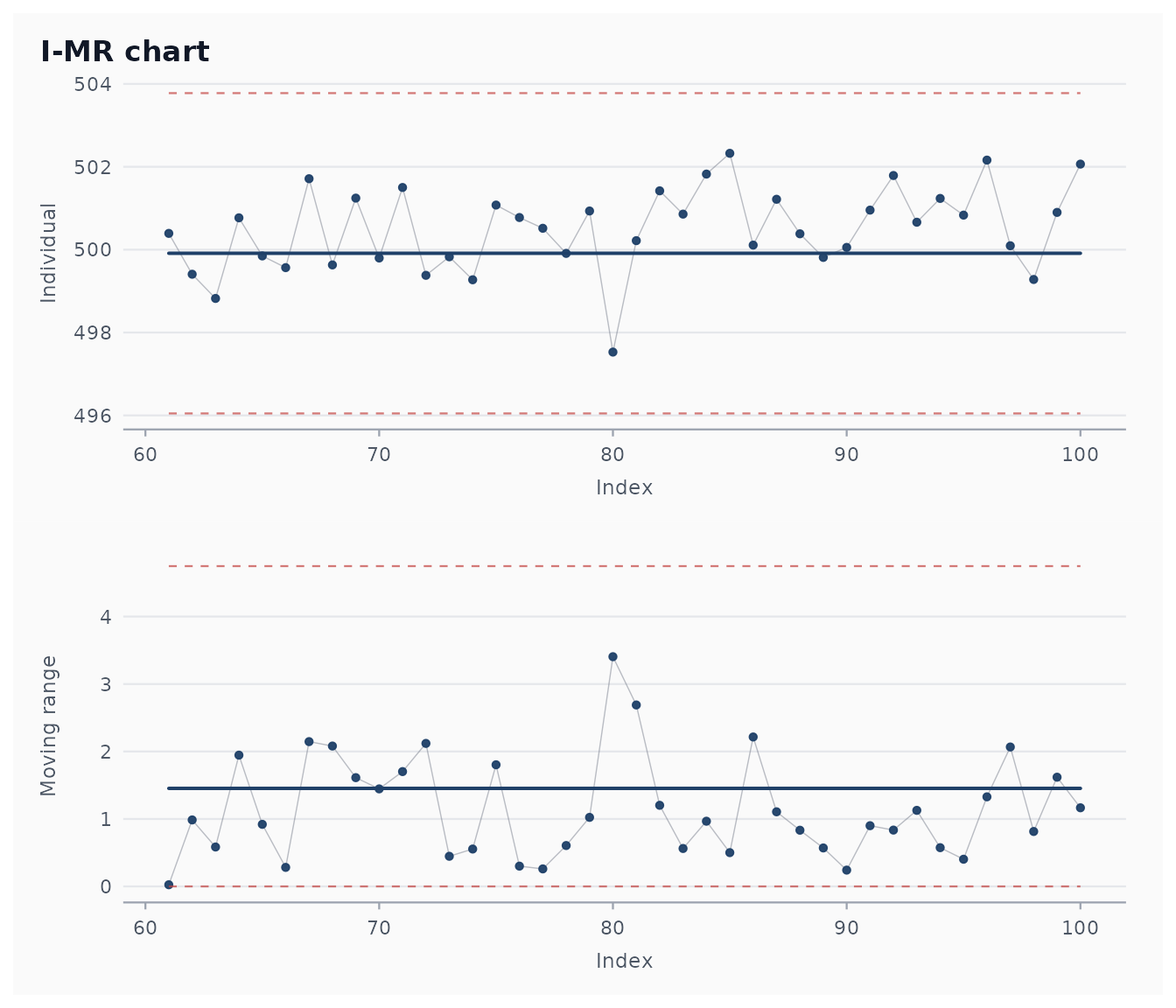
Why the trim step matters
Suppose your baseline contains a single contaminated observation — say, the time the operator forgot to recalibrate the scale. If you include it, the moving range will be inflated, sigma will be overestimated, and future alarms will be too lenient. The trim step iteratively removes such contamination from the calibration data.
You can disable trimming if you don’t trust automatic outlier removal:
calib_no_trim <- calibrate(baseline, value = ml,
                           chart = "i_mr",
                           trim_outliers = FALSE)
calib_no_trim$sigma_hat
#> [1] 1.288322
calib$sigma_hat       # potentially smaller after trimming
#> [1] 1.288322
The general principle (Tukey 1977): an analyst should look at the
data before trusting any automated calibration. Use
shewhart_diagnostics() and the runs-violation table to
interrogate your baseline before declaring it “in control”.
When this matters most
The Phase I / Phase II distinction is most consequential when:
- The process has evolved (operators, materials, environment) since the historical baseline was collected. Limits estimated on the old data may misfit new operating conditions.
- A small sustained shift is present. Re-estimating limits each monitoring run masks slow drifts.
- You will compare different time periods. Without fixed limits, a comparison is between two estimates rather than against a single reference.
References
- Woodall, W. H. (2000). Controversies and Contradictions in Statistical Process Control. Journal of Quality Technology, 32(4), 341-350.
- Montgomery, D. C. (2019). Introduction to Statistical Quality Control (8th ed.). Wiley. Section 6.2.3.
- Champ, C. W., & Woodall, W. H. (1987). Exact Results for Shewhart Control Charts with Supplementary Runs Rules. Technometrics, 29(4), 393-399.
- Tukey, J. W. (1977). Exploratory Data Analysis. Addison-Wesley.