Every Shewhart chart silently makes assumptions about its residuals: that they are independent (not autocorrelated), approximately normal (or at least symmetric and unimodal), with constant variance over time. When the assumptions hold, the chart’s nominal false-alarm rates apply. When they don’t, the chart can be either too lenient or too strict, and either way you cannot tell from the chart itself.
shewhart_diagnostics() produces a five-panel residual
diagnostic display. It is a working tool, not a polished figure: the
point is to surface the assumptions, not to print them.
What the panels show
fit <- shewhart_i_mr(bottle_fill, value = ml, index = observation)
shewhart_diagnostics(fit)
#> Warning: Removed 1 row containing missing values or values outside the scale range
#> (`geom_line()`).
#> Warning: Removed 1 row containing missing values or values outside the scale range
#> (`geom_point()`).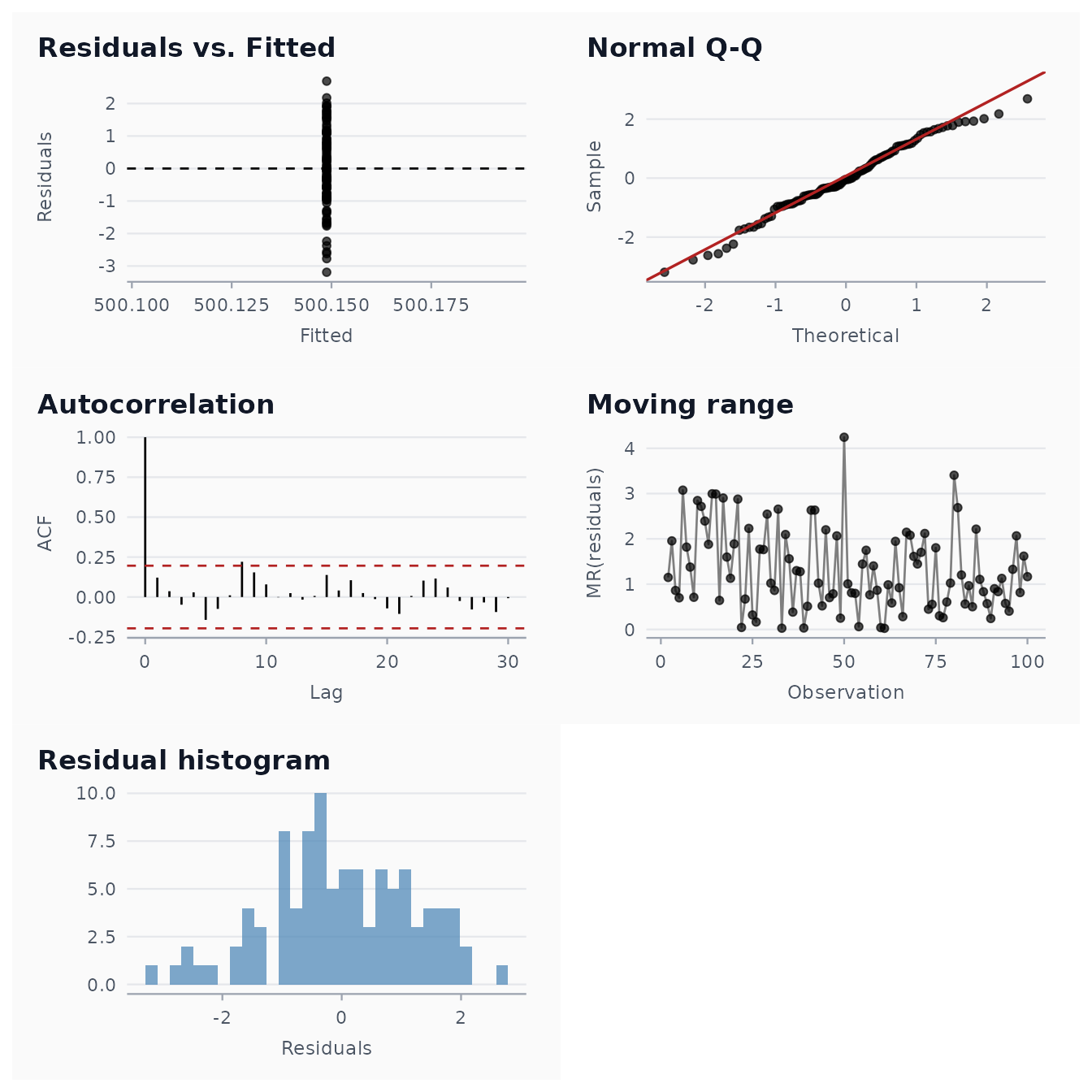
| Panel | Reads as |
|---|---|
| Residuals vs. fitted | Trend or non-constant variance in residuals? |
| Normal Q-Q | Heavy tails, skew, gross departures from N |
| ACF | Are residuals correlated in time? |
| Moving range | Drift in dispersion? |
| Histogram | Symmetry and unimodality |
The Q-Q and histogram address normality. The ACF plot and the moving-range trace address independence and stationarity. The residuals-vs-fitted plot catches non-linearity and heteroscedasticity.
This panel is what John Tukey called the exploratory phase of any analysis: before you trust an answer, look at the working. Box’s remark applies — “all models are wrong” — but the residual panel tells you how wrong, and whether the wrongness matters.
A diagnosis-driven fix: Box-Cox
If the histogram or Q-Q reveals strong skew, the chart’s nominal limits won’t give the advertised coverage. The classical fix is a Box-Cox transformation:
bc <- shewhart_box_cox(bottle_fill, value = ml)
print(bc)
#>
#> ── Box-Cox profile likelihood ──────────────────────────────────────────────────
#> • n = 100
#> • lambda_hat = 2
#> • 95% CI: [-2, 2]
ggplot2::autoplot(bc)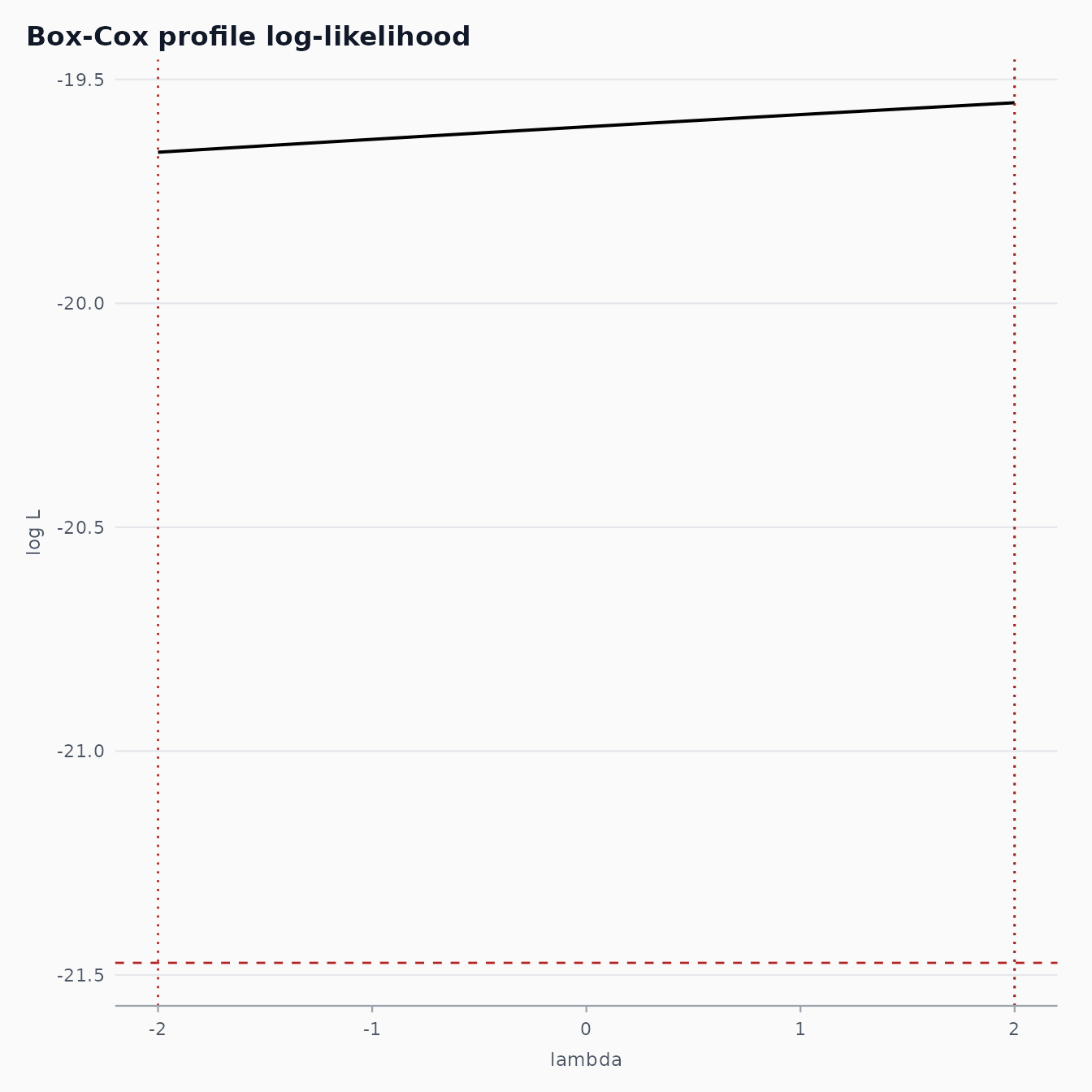
The maximum-likelihood lambda and its 95% CI are returned. If 1 falls inside the CI, no transformation is needed; if 0 does, take logs; otherwise apply to the data and re-fit the chart.
shewhart_regression(model = "auto") calls
shewhart_box_cox() internally and picks among
linear, log, loglog based on the
profile-likelihood maximiser. For full control, run the diagnostic
yourself and pass model (or formula)
explicitly.
When non-normality is a feature, not a bug
Counts and proportions are non-normal by construction; that is why attributes charts use Binomial / Poisson limits, not transforms. Diagnostics on a c-chart’s residuals will show discrete jumps and non-normal tails by construction; that is fine. The statistical honesty here is to use the right distribution from the start, not to transform until residuals look normal.
References
- Tukey, J. W. (1977). Exploratory Data Analysis. Addison-Wesley.
- Box, G. E. P., Hunter, W. G., & Hunter, J. S. (2005). Statistics for Experimenters (2nd ed.). Wiley.
- Box, G. E. P., & Cox, D. R. (1964). An Analysis of Transformations. Journal of the Royal Statistical Society B, 26(2), 211-252.
- Atkinson, A. C. (1985). Plots, Transformations and Regression. Oxford.